


WHY THERMAL?
Eliminates Uncertainties
A remedial solution should be both certain and final. The ability to achieve performance-based goals is a testament to the reliability and predictability of our technologies. Performance-based contracts are available for most applications, and unlike other technologies, the application of thermal remediation eliminates "rebound" of contaminants. There is no place to hide: thermal remediation removes organic contaminants from a diverse series of lithologies, including clays, silts, sands, sandstone, and fractured rock.
Minimal Neighborhood Nuisances
No excavation and no transportation of soil (trucks, accidents, dirty roads, dust, etc.) necessary. Projects have been implemented beneath businesses, buildings, apartments, and even homes.
Competitive Pricing
The total cleanup costs with GTR™ are very competitive, especially when considering the full remediation costs:
-
No long term liabilities (and no uncertainty associated with it)
-
Restoration of full property value
-
No long term monitoring
-
No disruption of operations during remediation
-
Time value of money: remediation cycle of less than one year
When all costs are taken into account, thermal is often the most economical choice.
Applicable to a Wide Variety of Contaminants, Soil Types, and Configurations.
Nearly all organic contaminants and a few inorganic contaminants are suitable for GTR™ treatment. The technology works effectively in all soil types as conductive heat progresses quasi-homogeneously throughout the different soil types.
Often the Most Sustainable Remediation Option
GTR™ is a very sustainable option compared to more traditional alternatives:
-
After treatment, land usage is often unrestricted. With ISTD using GTR™, land is no longer limited in its usage to low-level industry. It is fit for any use.
-
Low energy consumption: The efficient burners, combined with the use of "clean" natural gas or propane, make ISTD with GTR™ very energy efficient.
-
No electrical upgrades: Usually, no electrical upgrades are required at the project site. When natural gas is unavailable, the GTR™ units operate from mobile propane tanks.
-
Heater wells can be reused as geothermal heat storage units. With the reuse of the remediation device as heat storage unit, total CO2 impact can be reduced to a minimum and in some cases even be totally neutralized, benefitting redevelopment projects.
THERMAL REMEDIATION
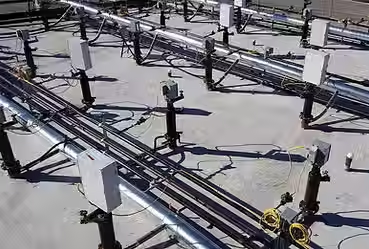
Thermal Conduction Heating (TCH) is one of the most robust and frequently deployed methods of In Situ Thermal Remediation. GEO’s patented GTR® technology allows natural gas, propane or liquid fuel to be used to power the TCH system. Common benefits of using the GTR® method vs. electrical heating are:
No electrical upgrades required at many projects
Existing natural gas supply sufficient at small-to-medium sites
System is modular with no complex central distribution systems
Standard heaters provide up to 2 kW per meter length output

Types Of Fuel
These fuels can be used in GEO Burners in IN-Situ and EX-Situ sits.

Natural Gas
Natural gas is the common fuel source used in GEO burners as it is plentiful and cheap compared with other fuels.

CNG
Compressed Natural Gas available as a stand alone fuel or as a supplement to natural gas in large wellfields.

Hydrogen
A newer fuel source, GEO burners have undergone rigorous testing and have demonstrated remarkable adaptability to hydrogen as a fuel source. The extensive trials and tests conducted have validated their capacity to efficiently and effectively utilize hydrogen, marking a significant stride towards sustainable energy solutions

Diesel
Diesel used in locations where natural gas is not available. Particularly suited to remote locations.

Propane
Propane used in locations where natural gas is not available. Particularly suited to remote locations.
WHY THERMAL?
Eliminates Uncertainties
A remedial solution should be both certain and final. The ability to achieve performance-based goals is a testament to the reliability and predictability of our technologies. Performance-based contracts are available for most applications, and unlike other technologies, the application of thermal remediation eliminates "rebound" of contaminants. There is no place to hide: thermal remediation removes organic contaminants from a diverse series of lithologies, including clays, silts, sands, sandstone, and fractured rock.
Minimal Neighborhood Nuisances
No excavation and no transportation of soil (trucks, accidents, dirty roads, dust, etc.) necessary. Projects have been implemented beneath businesses, buildings, apartments, and even homes.
Competitive Pricing
The total cleanup costs with GTR™ are very competitive, especially when considering the full remediation costs:
-
No long term liabilities (and no uncertainty associated with it)
-
Restoration of full property value
-
No long term monitoring
-
No disruption of operations during remediation
-
Time value of money: remediation cycle of less than one year
When all costs are taken into account, thermal is often the most economical choice.
Applicable to a Wide Variety of Contaminants, Soil Types, and Configurations
Nearly all organic contaminants and a few inorganic contaminants are suitable for GTR™ treatment. The technology works effectively in all soil types as conductive heat progresses quasi-homogeneously throughout the different soil types.
Often the Most Sustainable Remediation Option
GTR™ is a very sustainable option compared to more traditional alternatives:
-
After treatment, land usage is often unrestricted. With ISTD using GTR™, land is no longer limited in its usage to low-level industry. It is fit for any use.
-
Low energy consumption: The efficient burners, combined with the use of "clean" natural gas or propane, make ISTD with GTR™ very energy efficient.
-
No electrical upgrades: Usually, no electrical upgrades are required at the project site. When natural gas is unavailable, the GTR™ units operate from mobile propane tanks.
-
Heater wells can be reused as geothermal heat storage units. With the reuse of the remediation device as heat storage unit, total CO2 impact can be reduced to a minimum and in some cases even be totally neutralized, benefitting redevelopment projects.
GEO provides operations, maintenance and site management services at environmental remediation projects. GEO is experienced in operating common remedial technologies such as soil vapor extraction, dual- and multiple-phase extraction, groundwater pump & treat, and air sparging and vapor intrusion mitigation systems.
